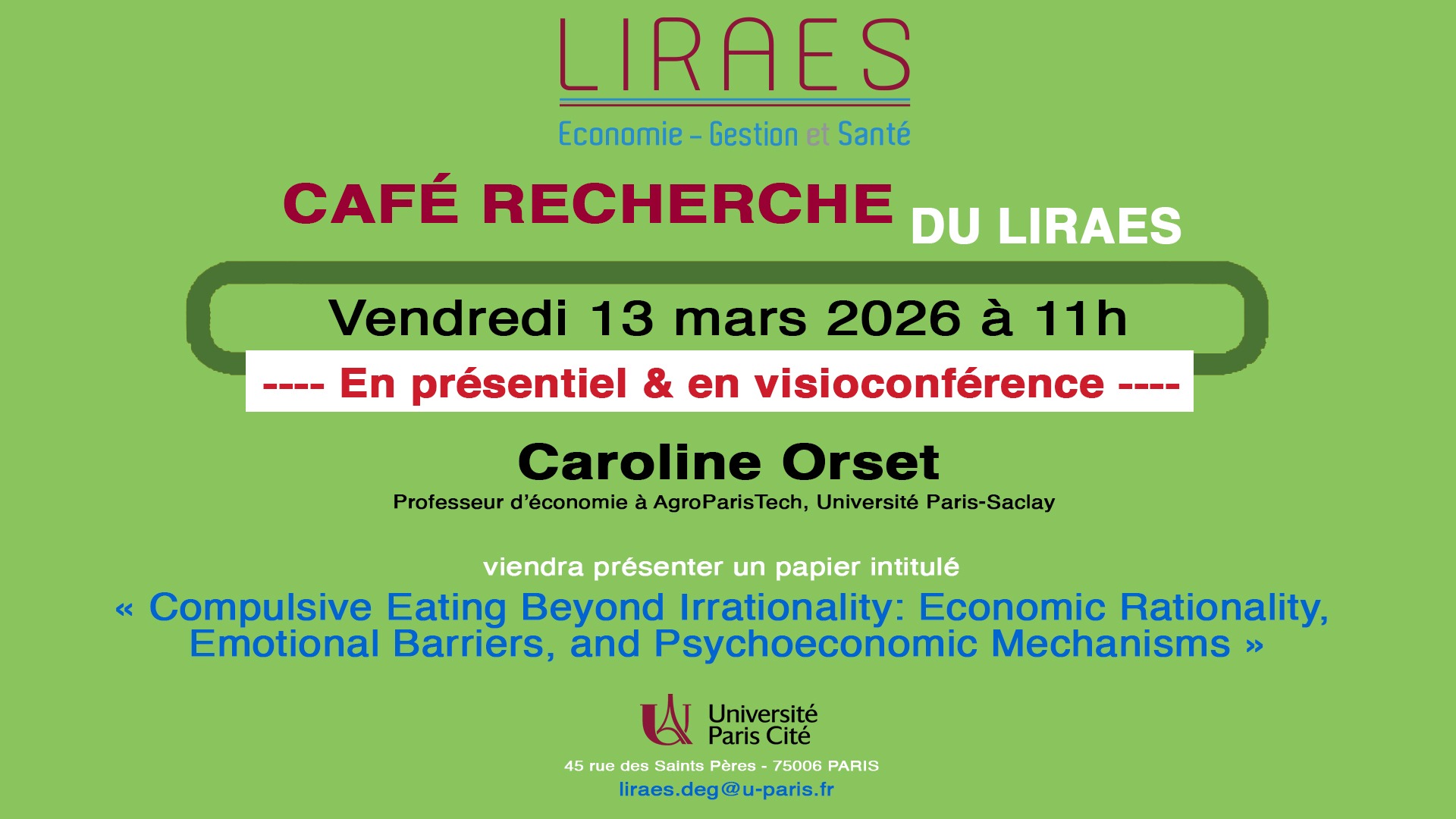
Dans le cadre des cafés recherche du LIRAES, organisés par Bertrand Chopard, Caroline Orset, Professeur d’économie à AgroParisTech, Université Paris Saclay, viendra présenter un papier intitulé “Compulsive Eating Beyond Irrationality: Economic Rationality, Emotional Barriers, and Psychoeconomic Mechanisms“.
—
Résumé :
Compulsive eating represents a growing public health concern and is commonly interpreted, within economic and behavioural frameworks, as the manifestation of impaired self-control, present bias, or limited rationality. This paper revisits this interpretation by combining experimental economics, health economics, and a psychoeconomic framework to provide a unified analysis of compulsive eating behaviour. First, using experimental tasks measuring fairness preferences, strategic reasoning, intertemporal choice, and risk attitudes, we show that individuals with compulsive overeating do not exhibit systematic deviations from standard models of economic rationality. Their choices are largely consistent with equilibrium behaviour, exponential discounting, and expected utility, and in some strategic contexts they display enhanced anticipatory reasoning relative to non-compulsive controls. Second, we investigate treatment acceptance using a contingent valuation approach. Despite preserved rationality, willingness to accept and willingness to pay for treatment are low, revealing substantial economic and emotional barriers to care. Emotional distress, co-occurring compulsive behaviours, and exposure to screening or prevention campaigns significantly affect treatment acceptance, while many individuals underestimate the severity of their condition. Finally, we propose a psychoeconomic framework in which compulsive consumption arises as a rational response to unresolved psychological tension rather than as a failure of optimisation. Consumption functions as a substitute mechanism for tension regulation under internal and economic constraints. These findings challenge deficit-based models of compulsive behaviour and have important implications for economic theory and public policy, suggesting that effective interventions should leverage preserved rationality while addressing emotional and psychological determinants of behaviour.
—
ID de réunion : 883 7503 6073 – Code secret : 701516
Ces séminaires mensuels sont l’occasion pour les chercheurs en économie (de la santé) de présenter leurs travaux de recherche en cours.
La durée de chaque séminaire est d’une heure environ.